Fragrance by season · · 9 min read
Autumn and Winter in the North: The One Season Heavy Perfume Works
Hanoi and Hải Phòng get a genuinely cold, dry season, and it is the only time of year oud, tobacco, vanilla and amber are right. Why cold air changes how a fragrance behaves, how much to spray, and when to stop.

Almost every piece of fragrance advice written for Vietnam assumes one climate: hot, humid, all year, so wear something light. That advice is not wrong. It is simply advice for half the country, and for several months a year it is wrong for the other half.
This article is that other half. From roughly late September to the end of February, Hanoi, Hải Phòng and the whole Red River delta move into a stretch of weather that most Vietnamese fragrance writing treats as though it did not exist: the air dries out, the temperature falls, and a genuinely cold winter arrives, with mornings around 10 to 15 degrees and colder when a northern surge comes through. This is the only time of year the bottles you put away because they were "too much" are finally in the right place.
We are writing it because we get the same question in the same shape from customers in the north. They buy a gourmand or an oud, try it in June, find it suffocating, decide they are not a heavy-fragrance person, and put it in a drawer. The bottle was not the mistake. June was.
The north really does have four seasons, and two of them are worth dressing for
Northern autumn, roughly late September to the end of November, is probably the most comfortable stretch of weather anywhere in Vietnam. The light softens, humidity drops, the air moves dry, daytime sits in the mid-twenties and mornings have an edge to them. The heaviness of summer is gone and the hard cold of January has not arrived.
Then from around December to February there is a real winter. Cold and dry. Not a winter with snow in it, but cold enough that the whole city is in a padded coat, and more than cold enough to change how a bottle of perfume behaves on your skin. In Ho Chi Minh City, where it is 30 to 35 degrees all year and the only seasonal question is whether it is raining, a cold season is not a thing that happens. In the north it is, and it lasts long enough to justify owning a bottle or two that exist only for it.
What cold, dry air actually does to a fragrance
Perfume is a mixture of aromatic molecules dissolved in alcohol. For you to smell anything at all, those molecules have to evaporate off your skin, and how fast they do that depends heavily on temperature: the warmer it is, the faster and the more of them leave.
In heat, your skin is warm and often slightly damp, so everything lifts at once. Base notes such as vanilla, tonka bean, amber and wood, designed to emerge slowly over several hours, surface almost immediately. You skip straight to the densest part of the bottle and sit there all day. That is exactly the stuffy, airless, "far too strong" feeling everyone gets wearing something heavy outdoors at midday in May.
Cold, dry air does the opposite, and it does it thoroughly.
- Less lifts off. Cold skin slows evaporation. The scent stays close to you instead of filling the room.
- It projects less. Someone two metres away may smell nothing at all. This is the biggest change and the one that confuses people most.
- It lasts far longer. Precisely because it evaporates slowly, what is on your skin and your clothes is still there hours later. A four-hour scent in summer can still be legible at dinner in January.
- It opens in the right order. Top, heart and base arrive in sequence, the way the perfumer intended, instead of all at once. Complex compositions are only really audible in these conditions.
There is a consequence nobody tends to mention: in the cold you may need to spray a little more, not less. The amount you have trained yourself to use in summer, already dialled down to survive the heat, falls short in January. Not because the bottle has weakened, but because genuinely less of it is reaching anyone.
The same bottle is suffocating in Hanoi in July and exactly right in Hanoi in January. The bottle has not changed. The temperature has, and temperature is what decides how much of it anyone smells.
The families that finally work
This is when you open the drawer again. Everything below shares one trait: it is built on heavy, slow-evaporating molecules, and it needs cold air in order not to overwhelm.
- Oud and trầm hương. Agarwood is the resin-saturated heartwood of the Aquilaria tree, a material Vietnamese noses already know from incense burned at Tết and on death anniversaries. Oud is dense, resinous and faintly smoky, and in heat it swells so fast that it buries everything else. In cold dry air that same density reads as depth: it sits around you rather than arriving before you.
- Tobacco. Dry, warm and lightly sweet, somewhere between honey and dried fruit. In humidity it tips easily into something heavy and stale. In the cold it smells more like a warm wooden room than like smoke.
- Vanilla and gourmand. Vanilla, tonka bean, praline, caramel, dates. These are base notes, heavy and sweet, so on hot skin they cloy within minutes. In the cold the sweetness unfolds slowly and in layers, and gives the comforting warmth it was designed to give.
- Amber and resins. Benzoin, labdanum and their relatives are warm, slightly powdery, slightly honeyed. This family sits very close to traditional incense, which is why many Vietnamese wearers find it familiar on the first sniff, and it clings best of all to a coat.
- Leather. Dry, faintly smoky, sometimes a little bitter. In heat it turns harsh. In the cold it is formal in a useful way, and belongs with outerwear and evenings that call for effort.
- Heavier woods and spiced orientals. Cedar, patchouli and sandalwood alongside cinnamon, nutmeg and saffron. Spices do not flash off in cold air, so they keep cutting across the sweetness and giving the scent structure instead of one flat tone.
The common thread: every one of these is a bottle you would describe in June as too much. In January, the too-much is the reason you bought it.
An office is still an office, even in winter
This is where people overshoot. Cold outside does not mean cold in the meeting room. A Hanoi office in winter still has the windows shut, still runs the air conditioning on heat, and is still a shared space where two desks sit a metre apart. A sealed, still room holds scent in place rather than dispersing it, so your fragrance pools around you for the whole morning.
There is a second trap. You have come in from the cold, your nose is cold, and your sense of smell is temporarily dulled, so your own scent reads as fainter than it is. Then you sit down, you warm up under a jumper, and everything you sprayed at seven starts to open in a room with no ventilation.
A few things we suggest:
- Save the generous application for weekends and evenings. On a workday, keep the one or two sprays you already use.
- Spray the coat rather than your neck if you plan to take the coat off indoors. The scent then goes to the hook with the coat instead of into the meeting with you.
- Do not judge strength immediately after spraying on a cold morning. Wait until you have warmed up, around half an hour, and judge it then.
October is not December
A common mistake is treating the whole autumn-to-winter stretch as a single block. Early October in Hanoi still reaches the high twenties by lunchtime. Mid-January is twelve degrees. The bottle that is perfect in January is too much this week. Treat autumn as a transition with its own rules rather than as a weak winter.
- Change the dose before you change the bottle. Your winter fragrance at one spray instead of three is perfectly wearable through October and November. It is the cheapest fix available.
- Use woody-fresh as the bridge. Dry woody scents with a little spice or a citrus opening sit exactly between the summer group and the winter group: they do not fall flat while it is still warm and they do not feel out of place once it is cold.
- Spray low. Mid-chest, under a layer, the inside of the elbow. The scent rises gradually instead of arriving straight in the face of whoever you are talking to.
- Hold the heaviest bottles for genuinely cold occasions. Dinners out, late-season weddings, and above all the Tết days spent moving from house to house in a coat.
Five bottles that suit cold, dry air
This is not a ranking. These are five bottles whose structure illustrates everything above particularly clearly.
- Tom Ford Tobacco Vanille (EDP) is built on tobacco leaf, vanilla, cacao, tonka bean and dried fruits. Close to the definition of a cold-weather fragrance: very dense, very tenacious, and honestly too heavy for daytime in Vietnam for most of the rest of the year. One spray inside the collar of a coat carries a January evening on its own.
- Kilian Paris Angels' Share (EDP) brings cognac, cinnamon, praline, oak, vanilla and sandalwood. Sweet in a dessert sort of way, but the spirit and the wood hold it down so it never goes flat. A bottle for dinner in a cool room and for days when it is properly cold.
- Dior Homme Intense (EDP) goes somewhere else entirely: powdery iris with lavender and pear, over Virginia cedar, vetiver and leather. The most formal of the five, it reads as a suit, and it struggles in humidity. Cold dry air lets the powdery side of the iris stay smooth instead of turning sour.
- Initio Oud for Greatness (EDP) has saffron, nutmeg and lavender, then oud and patchouli, over musk, sandalwood and amber. A modern oud, a good deal cleaner than a traditional attar. Strong and long, so winter is the rare moment when that strength is not a problem. Still start with one spray.
- Lattafa Khamrah (EDP) combines dates, cinnamon, nutmeg, praline, vanilla, tonka bean and benzoin. A properly built gourmand oriental, and the least expensive way to find out whether the heavy-sweet family suits you in the cold. It suits Tết visiting particularly well.
If the heavy families are new to you, we usually suggest working up that list from the bottom: a spiced gourmand first, then oud or tobacco.
Then nồm ẩm arrives, and that is when to stop
Winter in the north does not hand over to a pleasant spring. It hands over to nồm ẩm, roughly February to April, which happens when warm, moist air arrives over walls, floors and furniture still cold from winter. The moisture condenses onto every surface. Floors sweat, washing never quite dries, and humidity sits close to saturation for days at a stretch.
Fragrance behaves badly in that. Air already saturated with water does not thin a scent out; it leaves it hanging around you like a curtain. Everything smells heavier than it is, including the room, and including you. The problem is that the thermometer has not risen yet. It still feels cool, so by habit people keep spraying their January dose. This is the time of year we hear "too strong" more than any other, summer included.
So treat nồm as a hot season rather than as the tail of winter:
- Go back to one or two sprays, even though it does not feel like weather that requires restraint.
- Put the heaviest bottles away. Not because they have spoiled, but because they cannot be read properly in that air.
- Move to lighter groups: citrus, fresh woods, or whatever you normally save for summer.
- Do not re-spray because the scent seems to have vanished. Most of the time your own nose has simply adapted, and everyone around you can still smell it clearly.
Put another way, the heavy-fragrance season in the north has a fairly clear start and end: it starts on the first genuinely cool morning of the year, and it ends when the walls begin to sweat.
Flying from Hanoi to Ho Chi Minh City in January
One more situation happens to a great many people and is almost never accounted for. The flight from Hanoi to Ho Chi Minh City takes about two hours. You leave Nội Bài at twelve degrees in a padded coat and land at Tân Sơn Nhất at thirty-two. That is a twenty-degree swing inside one morning.
The fragrance you sprayed at six does not make that journey with you. The amount that was right in Hanoi, already sprayed more generously because the cold was absorbing the projection, flares the moment you take the coat off in the south: pleasant on the way out of the door, mortifying by the time you reach the meeting.
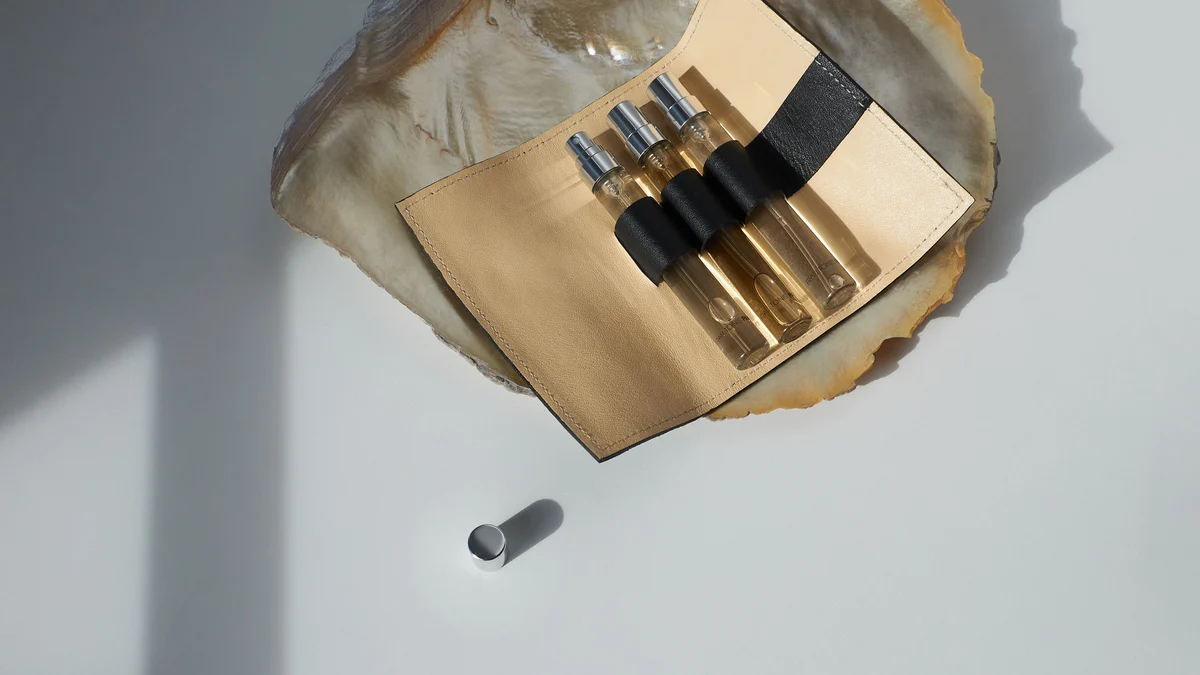
It runs in both directions, and it happens to anyone who lives at one end of the country with work or family at the other. It is also the most practical argument we know for keeping a few small bottles rather than one large one. A 100 ml bottle bought for a Hanoi winter sits unused for eight months of the year, while two 10 ml decants give you something heavy for the cold snap and something light for the flight south, both in the same small pouch. It is the same reason we suggest wearing a cold-weather scent through a whole cold spell before committing to a full bottle: a workday morning, an evening out, a day when the northern wind arrives, a dry bright day.
In short
The north has a fragrance season of its own, four or five months long, and it looks nothing like the advice written on the assumption that Vietnam is always hot. If there is a bottle you bought and shelved because it "did not suit the Vietnamese climate", take it out again this week. The odds are good that you did not choose the wrong bottle. You just tried it in the wrong month.
Sources
- Note (perfumery) · Wikipedia
- Volatility (chemistry) · Wikipedia
- Olfactory fatigue · Wikipedia
- Agarwood · Wikipedia
- Hanoi · Wikipedia
- Angels' Share - Perfume - The Liquors | KILIAN PARIS · Kilian Paris
Written by The Vialdee team