Choosing a scent · · 7 min read
Office and Interview Perfume: Safe Scents for Work
Office and interview perfume: how to smell just right in air-conditioned rooms, lifts and closed meeting rooms. Scent families, spray technique and dosage.
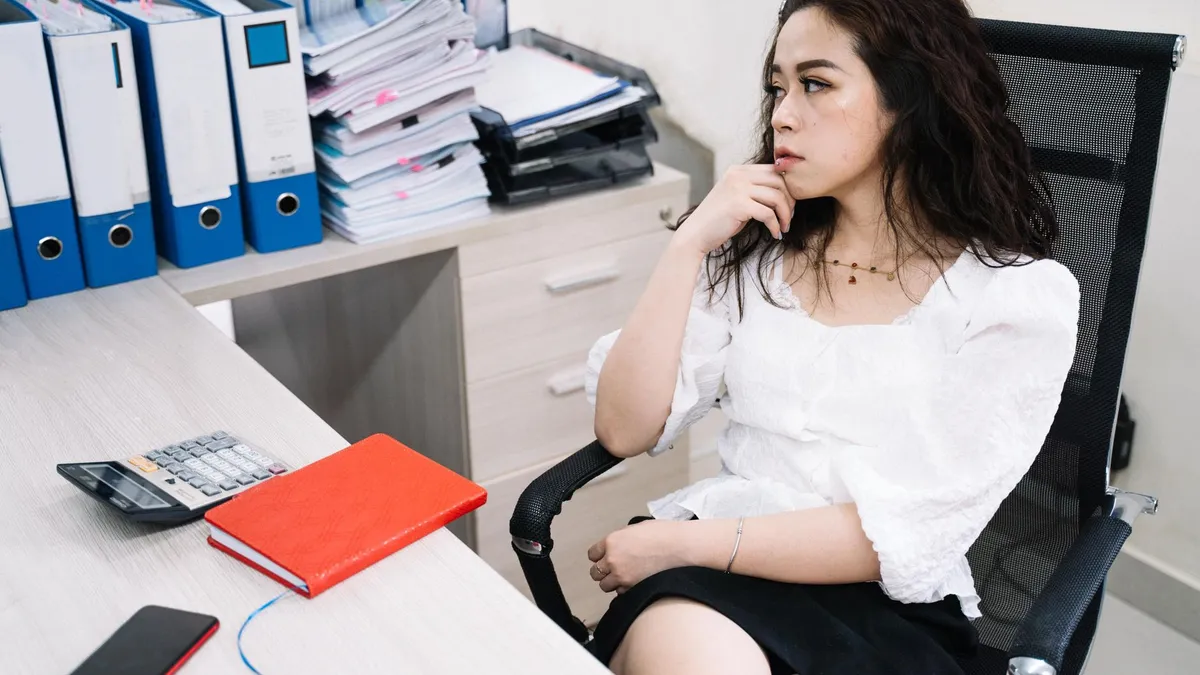
There is one situation almost everyone who works in Vietnam will recognise: you have just ridden your motorbike for twenty minutes in the sun, you take off your helmet, peel off your sun jacket, and step into a packed office lift. The lift goes from the basement to the 14th floor. For that one minute, your smell is something the person next to you cannot escape.
Office perfume is not about choosing the most beautiful scent. It is about choosing one that can handle an enclosed space, handle the sweat from the commute, and not force anyone to pay attention. Interviews are a notch stricter still, because you are sitting across from a stranger in a small room with the door shut and the air conditioning running, and you do not get a second chance to fix it. This piece is about how to choose and how to apply for those two situations.
Why Vietnamese offices are harder than you think
Most "office fragrance" advice online is written for temperate climates, where people walk from the car park into the building in cool weather. Here it is different.
First, heat. Warm skin burns through the top notes faster and pushes the heart notes up early. A bottle that felt gentle when you tried it in an air-conditioned shop can project noticeably harder in the first half hour if you spray it at 7am and then sit in the Saigon sun.
Second, sweat. Perfume does not always get along with old sweat. Scents with cumin, heavy musks or sweet amber easily go "off" when mixed with the sweat on a shirt.
Third, enclosed spaces. Offices here are usually sealed to keep the cold in, desks are pushed close together and meeting rooms are small. Air barely circulates, so the smell builds up. The same number of sprays reads far stronger indoors than outside.
Fourth, regional differences. In Ho Chi Minh City and the Mekong Delta it is hot almost all year, so you nearly always walk into the office having just come in from the sun. In Hanoi, roughly December to February is cold and dry, scent clings to wool and scarves for a long time, and you can wear something denser. But come the "nom am" season in March and April - the damp, muggy spring - humidity is high and scent seems to hang in the air and linger. Central Vietnam during the Lao wind season is hot and dry, scent burns off quickly and you have to accept a midday respray; during the storm season at the end of the year it is very humid, so bring the dose down.
An easy rule to remember: at the office, your scent should be something people only notice when they are an arm's length away. Any further than that is too much.

Interviews: should you wear perfume at all?
Some people advise wearing nothing at all to an interview. That advice is not wrong, especially in healthcare, restaurant kitchens, or companies with clear scent-free policies. But for most office jobs in Vietnam, a very light layer actually helps: it shows you have prepared properly, and it covers the smell of sweat after the motorbike ride.
The issue is dosage. For an interview, we think you should drop to something close to the minimum:
- One spray. Two at most, and the second only if you know that bottle is weak.
- Spray onto skin on the chest or the nape below the collar, not on the wrists if you are going to shake hands or pass over documents.
- Spray at least 30 minutes before leaving the house. The top notes are the loudest part, so let them burn off on the way.
- Do not respray just before walking into the room. By then your nose has adapted and you will overdo it without realising.
- Do not wear a newly bought bottle to an interview. Use one you have worn several times and know how it behaves on your skin after four hours.
Safe families for an interview are usually clean citrus, soapy scents, pale woods and green tea. Avoid oud, avoid heavy sweet gourmands of the vanilla-caramel type, avoid tuberose and strong white florals, and avoid anything with "intense" or "extrait" on the label, unless you are doing exactly one spray from a distance.
A few specific directions
Acqua di Parma Colonia is the classic citrus cologne style, lemon and bergamot up top, with lavender, verbena and rosemary, settling onto a light sandalwood base. It is clean, gender-neutral and modest in projection. The drawback is short longevity, which is simply how an EDC with a low oil concentration works, so do not expect it to still be there after lunch.
Jo Malone London Lime Basil & Mandarin goes in the same direction, but the basil and thyme make it less sweet and slightly green. It suits people who do not like scents that are too polished.
Issey Miyake L'Eau d'Issey Pour Homme EDT is a familiar office choice for men: woods blended with aquatic notes, yuzu and bergamot lemon on top, lotus in the middle, vetiver and cypress underneath, thin and clean. It is the kind of pleasant scent that rarely provokes a negative reaction.
If you want something close to invisible, Juliette Has a Gun Not a Perfume revolves almost entirely around ambroxan (cetalox). Ambroxan has a woody, musky, slightly salty character, so it reads less like perfume and more like clean human skin. Many people use it as their base layer for work for exactly this reason.
Everyday office perfume: a little more room
An interview is one session. Work is five days a week, and you are allowed more personality, as long as you control the dose.
Citrus and cologne. The safest option, and the best match for southern sun. The limitation is short longevity, so you will need to carry a 5ml decant for an afternoon respray. That is also why many working people prefer decants to full bottles: they fit in a shirt pocket or a desk drawer, with no risk of dropping a big bottle.
Dry woods and ambroxan. Bleu de Chanel EDP, Dior Sauvage EDP, Terre d'Hermès. This is a grey area. They suit the office in terms of style, but they project quite strongly in a closed room. If you wear them, drop to one or two sprays and apply under your clothing rather than on an outer layer.
Green and fresh. Diptyque Philosykos with fig leaf and a touch of coconut, or Jo Malone London Wood Sage & Sea Salt with its sea salt and driftwood tones. Both feel airy, not sweet and not clingy. Good for humid, muggy days.
Light florals and musks. For women who want to wear something without being noticed. Chanel Coco Mademoiselle is stronger than "light", so if you wear it at the office keep it to one spray, ideally on the hair or the hem of a garment so it releases slowly.
Save these for the evening. Tom Ford Tobacco Vanille, Initio Oud for Greatness, Lattafa Khamrah, Baccarat Rouge 540. Not because they are not beautiful, but because they are built to project far and last long. In a meeting room with ten people, they will become the subject of the meeting.
Spray technique for days you ride a motorbike
Commuting by motorbike changes the whole equation. The wind blows the top notes away, the helmet traps heat at the neck and nape, and the sun jacket holds in warmth.
Here is an approach that works:
- Spray after showering, onto slightly damp skin, before getting dressed. Damp skin holds scent better than dry skin.
- Choose spots covered by clothing: upper chest, the nape below the collar, the inner elbow. These places are less exposed to the wind.
- Do not spray a bare nape if your helmet has a strap that sits against the neck. The heat and sweat there will push the scent up suddenly when you take the helmet off.
- Do not spray a sun jacket or outer layer. Take it off at the office and the scent disappears with it, then you carry the scent home on a garment that does not get washed often.
- If the ride is long and you sweat a lot, consider spraying once you have arrived at work, after wiping your face and settling down. Carrying a decant is the easiest way to do this.
On the number of sprays: two to three for a mid-range EDT, one to two for an EDP, one for a parfum or extrait. If you sit in a closed room with colleagues right beside you, take one spray off those numbers.
How to tell whether you are wearing too much
The biggest problem is that after fifteen minutes you can barely smell yourself. The nose adapts very quickly: with continuous exposure to a smell, your sense of its intensity fades, and it takes time for the nose to recover. A few practical checks:
- Ask a colleague you trust, straight out, around 10am: "when I walked past earlier, could you smell anything?" An honest answer is worth more than any article.
- Watch for reactions. The person next to you sneezing, pushing their chair back, or opening the meeting room door is a signal.
- Test it in the lift. If you step into a crowded lift and can smell yourself bouncing back, you have overdone it.
- Count again. If you need a respray before 2pm just to feel "scented", chances are your nose has adapted rather than the scent having gone.
Test first, then think about a full bottle
Office scents are the hardest category to buy blind. They have to suit your skin, your commute, and how densely people sit around you. A bottle praised as an "absolute office scent" on foreign forums can be far too heavy for a 20 square metre workroom in Vietnam.
The sensible approach is to take one or two 5ml decants and wear them for a full working week, through sunny days and rainy ones, through meetings and through days sitting alone. Five days is enough to know whether it fits, and 5ml is enough for five days. If it works out, there is still plenty of time to think about a big bottle.
And if you are preparing for a specific interview next week, the shortest advice is this: take something clean and citrus or something close to scentless, do one spray, do it early, and stop thinking about it. The only job your perfume has that day is not to bother anyone. The rest is between you and the interviewer.
Sources
- Eau de toilette · Wikipedia
- Olfactory fatigue · Wikipedia
- Ambroxide · Wikipedia
- Issey Miyake L’eau d’Issey Pour Homme · Issey Miyake Parfums
Written by The Vialdee team