Wearing and storing · · 7 min read
How to Store Perfume in Hot, Humid Weather
How to store perfume in Vietnam, north to south: nồm ẩm, the best and worst spots, whether the fridge works, and how to tell when a scent has turned.
You buy a full bottle, never finish it, and one day the scent is off - you open the cap to find the liquid has darkened and you no longer dare spray it. This happens a lot here. It is not because the perfume was poor quality, but because the weather in Vietnam is harsher on fragrance than most people realise.
What makes it harder than it looks is that Vietnam is not one climate. Advice written for Ho Chi Minh City does not fully cover a bedroom in Hanoi in March, and advice written for Hanoi says nothing useful about a Cần Thơ afternoon in May. So this article covers both: what heat, light and humidity actually do to a bottle, then what that means where you live, for full bottles and for decants, along with the signs that a scent has started to turn.
Perfume has three real enemies
Perfume is a solution of aromatic oils in alcohol. The things that change it fastest are:
- Heat High and fluctuating temperatures speed up the chemical reactions inside the bottle, so the scent shifts sooner. Top notes such as citrus, being the lightest and most volatile molecules, disappear first.
- Light, especially UV Direct sunlight darkens the liquid and alters the scent. Clear bottles kept out of their box are the most at risk.
- Air Every time you press the sprayer, air moves in to replace the perfume that has left. Oxygen causes the ingredients to oxidise, and the emptier the bottle, the more air there is. Certain compounds such as terpenes are also more likely to irritate the skin once oxidised.
There is one more factor people overlook: humidity, which we have in abundance. Moisture does not get inside the bottle directly, but it damages boxes and labels and makes screw caps and rubber seals degrade faster. That makes the bathroom the last place you should keep perfume, however convenient it may be - and in most Vietnamese homes the bathroom is a single wet room with no screen between the shower and the shelf, so every wash puts warm steam straight onto whatever is sitting there.
The same bottle, three different countries
The chemistry above is the same everywhere. What changes is which enemy is coming for your bottle this month.
The north: four real seasons, and then nồm ẩm
Hanoi and Hải Phòng get a proper summer - 35 to 38 degrees and heavy with moisture - and a winter that is genuinely cold and dry, down around 10 to 15 degrees. A bottle that lives in the same drawer all year therefore swings across a range no bottle in Saigon ever sees, and it is the swing, not the peak, that does the damage. A room that is 12 degrees in January and 36 in July is running your perfume through a slow annual cycle of expansion and contraction.
Then there is nồm ẩm, roughly February to April, and it is the worst storage condition anywhere in the country. Warm, wet air arrives over surfaces that are still cold from winter, and the moisture condenses onto everything. Floors sweat. Walls sweat. Humidity sits close to saturation for days at a time and mould blooms on anything porous.
For perfume this is a paperwork problem before it is a liquid problem. The glass and the juice are sealed; the cardboard box, the paper label and the fabric pouch are not. A brand box left on an open shelf through nồm ẩm can go soft, spotted and permanently musty, and a box that smells of mould is no longer protecting anything - it is a source of smell sitting against your bottle. Labels lift at the edges and never quite lie flat again.
What to do about it, in order of how much it helps:
- Get bottles off the floor and off outside walls. Those are the coldest surfaces, so they are where condensation lands first. A drawer at chest height inside an interior wall is far drier than the bottom of a wardrobe against the street side of the house.
- Keep boxes in a closed drawer or a lidded plastic box rather than on an open shelf. Add a sachet of silica gel if you have one; the ones that come in shoeboxes and snack packets are fine.
- If you run a dehumidifier or the dry mode on your air conditioner in one room during nồm ẩm, that is the room your perfume should live in. It is the cheapest fix available because you are already paying for it.
- Do not move bottles from a cold room into a warm one and back. Condensation forms on the outside of cold glass, which is how labels get ruined.
The centre: dry wind, then a great deal of water
Đà Nẵng and Huế get a hot, dry summer under the Lào wind, when the air is genuinely arid and indoor temperatures climb and stay high for weeks. Heat is the enemy in that stretch, and it is the steady, unrelenting kind: an upstairs room under a roof can sit warm all night, so the bottle never gets the overnight recovery it would get further south.
Then from roughly September to December the season turns over into heavy rain and flooding. Storage advice for those months is mostly about where things sit rather than how cool they are: anything you care about belongs above floor level, in a closed drawer, with the box kept dry. If your ground floor has ever taken water, your perfume should not be stored on the ground floor.
The south: the same day, every day
Ho Chi Minh City and Cần Thơ are the easy case to describe and the hardest to ignore, because nothing ever lets up. Thirty to thirty-five degrees all year, a dry season from roughly December to April and a rainy one from May to November, and an indoor temperature that barely changes between them. There is no cold season during which a poorly stored bottle quietly recovers. Whatever heat is doing to your perfume, it is doing it in January as much as in July.
The good news is that a constant climate is easy to plan for. One cool, dark, closed spot and you are done - you do not have to think about it again in March.
Where to store it, and where never to
The simple rule is: cool, dark, stable.
Good spots
- A drawer or wardrobe in a bedroom where the air conditioning runs regularly
- The brand's original box - keep it, it is the best light barrier you will ever get for free
- An inner shelf that is not in the direct path of the air con and not against a sun-facing wall
Spots to avoid
- Windowsills and dressing tables next to glass. They look lovely, but they turn a scent far faster than you would expect.
- The bathroom, where temperature and humidity swing with every shower, and where a wet room gives the steam nowhere else to go
- The top floor of a nhà ống. Tube houses are narrow and deep, and the upper floors bake under the roof through the afternoon and release that heat slowly all evening. If your bedroom is the top one, keep perfume downstairs, or at least in the lowest drawer of a piece of furniture standing against an interior wall.
- The car, which is the worst of all. A car parked in the sun can reach a cabin temperature more than 20 degrees Celsius above the outside air. Carrying a decant around in your car all day is effectively boiling your perfume. The same goes for the underseat compartment of a motorbike parked out in the open, which gets hot enough to matter and is exactly where a small bottle ends up being forgotten.
- A chung cư apartment where the air con is off all day and only switched on at night. The temperature moves several degrees daily. If you cannot avoid it, store bottles in the lowest drawer, where the swings are smaller.
If you remember only one thing, make it this: "Do not put perfume anywhere you would not want to sit for long." Hot, stuffy, sunny or clammy means the perfume does not like it either.
Can you keep it in the fridge?
Yes, and it often genuinely helps with citrus or bright, volatile scents such as Acqua di Parma Colonia (EDC) or Jo Malone London Lime Basil & Mandarin (EDC). But there are conditions. Use a wine or cosmetics fridge set to around 12-15 degrees, not the vegetable drawer, which is too cold and full of food smells. Most importantly, do not keep moving bottles in and out, because frequent temperature changes are worse than a steady room temperature.
That last point matters more in the north than anywhere else. During nồm ẩm, a bottle taken out of a cold fridge into a saturated room fogs over immediately and sits there wet, which is precisely what you were trying to avoid. If you are storing in a fridge through the spring, take the bottle out and let it come up to room temperature inside a closed drawer before you open the box.
If you do not have a dedicated fridge, a drawer in an air-conditioned room is perfectly enough for everyday use.
How long does perfume last?
There is no fixed number, as it depends on the formula and how it is stored, but here is a rough guide:
- Scents that change quickly Citrus, aquatic and crisp green compositions. The freshness of the top notes fades first. EDCs and lighter EDTs sit in this group.
- Scents that hold up Amber, woody and gourmand fragrances built on vanilla, tonka bean or patchouli tend to be more durable. Examples include Tom Ford Tobacco Vanille (EDP), with its tobacco leaf, vanilla and tonka bean, and Lattafa Khamrah (EDP), with cinnamon, dates, vanilla and tonka bean.
- Concentration matters Each strength has a different ratio of perfume oil to alcohol. EDT usually sits at around 5-15%, while parfum or extrait is more concentrated, and generally holds its scent longer than the more diluted versions.
The signs a scent has started to change: the first thing you smell on spraying is alcohol or a sour, metallic note; the colour is noticeably darker than when you bought it; or the liquid is cloudy with sediment. If that happens, do not force yourself to wear it on skin, as oxidised ingredients can irritate. Spray it inside your wardrobe or onto an old handkerchief instead and still get some use out of it.
One thing worth separating: if the box smells musty after a damp spring but the liquid sprays clean and looks the same colour it always did, the perfume is fine. Throw the box away, or dry it out, and carry on. A mouldy box and a turned fragrance are two different problems.
How to store decants so the scent stays true
Decants of 5 and 10 ml have one big advantage: you finish them quickly, so the scent barely has time to spoil. But there are things to watch, because small bottles have a higher ratio of air to liquid and tend to be carried around.
- Carry them in your bag, but never leave them in the car, in a motorbike compartment, or in a bag sitting in the sun
- Take them out and put them in a drawer when you get home. Do not leave them in a hot bag all day.
- Close the cap tightly every time. A spray bottle with a loose cap evaporates faster than you think.
- Do not shake the bottle for fun. Shaking needlessly increases contact between the perfume and the air.
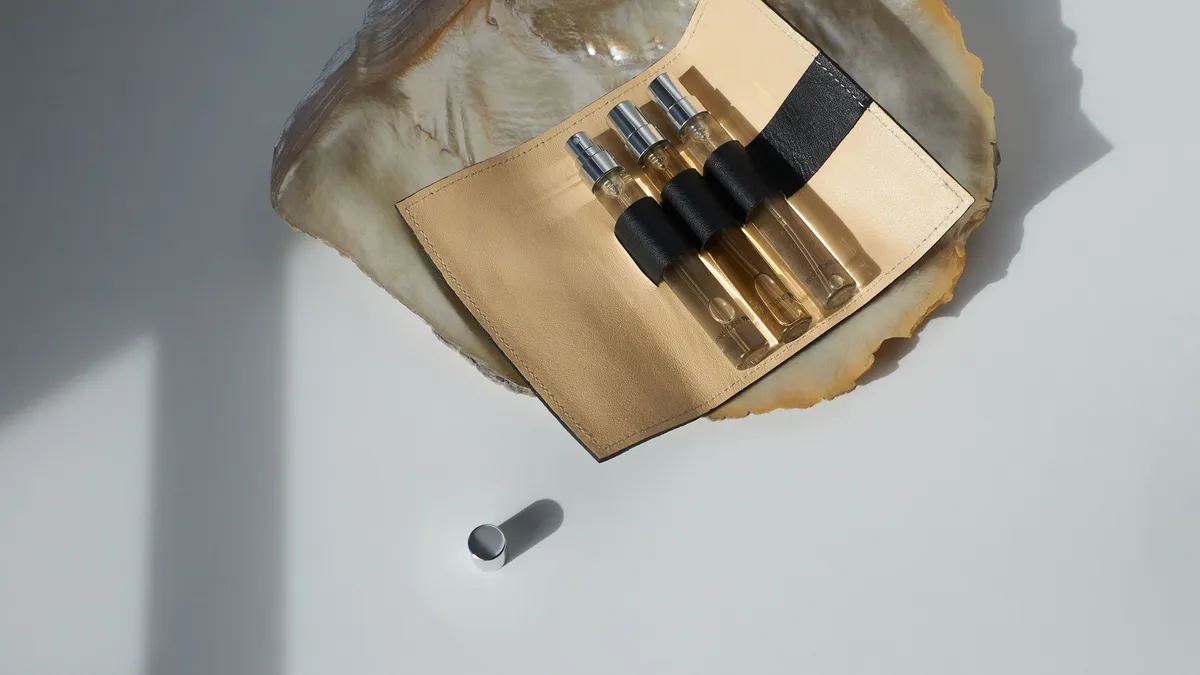
- If you have bought several scents to try before committing, keep them together in a small box or an opaque fabric pouch in the same drawer. Easy to reach and safe.
In truth, choosing a size that matches how much you actually use is the best way to preserve a scent. A 100 ml bottle used a few times a year usually ends up smelling nothing like it did on day one, while a small bottle finished within a few months gives you a fresh scent every single time you spray. That argument is stronger in the north than anywhere else: a 10 ml bottle bought in October is empty before nồm ẩm arrives, and a season your perfume never sits through is a season it cannot be damaged by.
A checklist before you put the bottle back
- Is the cap on?
- Does that spot get sun at any point in the day? Check in the afternoon.
- Is it near a TV, computer or any appliance that gives off heat?
- Is it on the floor or against an outside wall? In the north, move it before spring.
- Bottles with less than a quarter left should be used up within a few months
- Do you still have the original box? If so, put it to work - and keep the box somewhere closed, not on an open shelf.
Store it properly and the scent you love will still smell the same on the day you want it. It costs nothing extra: simply moving a bottle from the windowsill into a drawer already makes a difference.
Sources
- Note (perfumery) · Wikipedia
- Eau de toilette · Wikipedia
Written by The Vialdee team