Fragrance basics · · 8 min read
How to Test a Perfume Properly Before You Buy the Bottle
How to test perfume properly: why a paper strip only tells you the opening, how to wear a scent through a normal working day in Vietnam, and where a 5 ml or 10 ml decant fits.
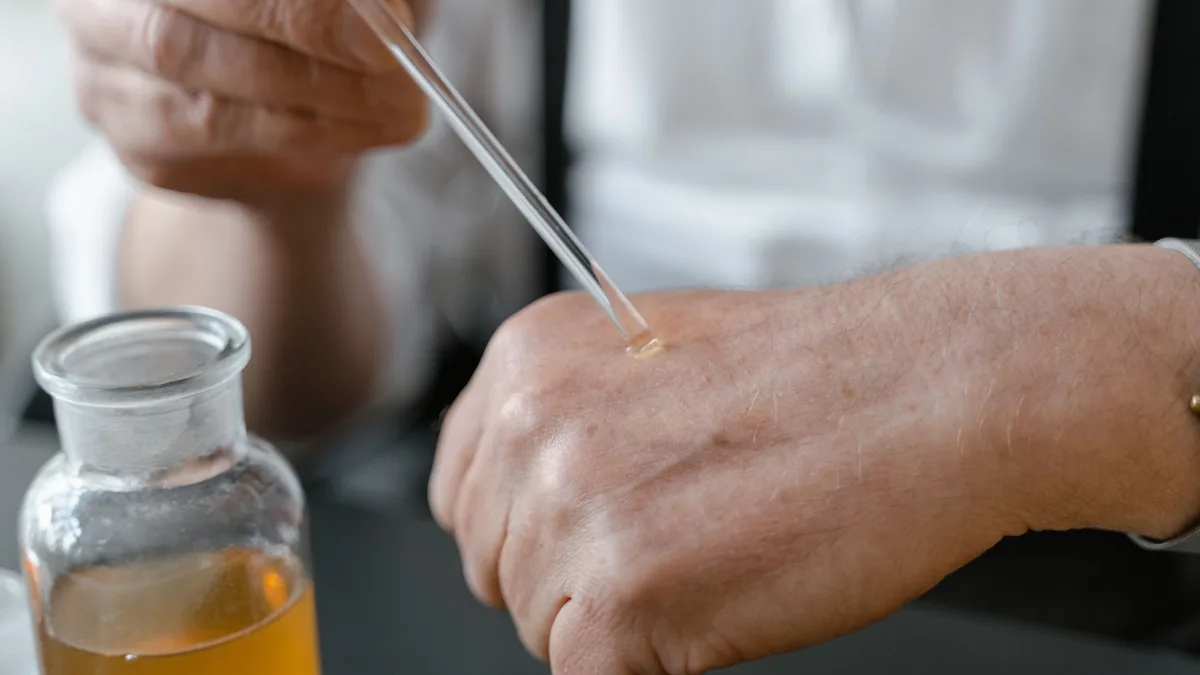
Almost everyone has done this at least once. You stop at a fragrance counter, the assistant sprays a paper strip, holds it up for you, and for the first three seconds you genuinely like it. You buy the full bottle. Three weeks later it is still standing on the dresser, and every morning your hand goes past it to the old one.
The problem is usually not your taste. It is the way the scent was tested. Three seconds at a counter shows you a very small part of a fragrance, and it happens to be the part that disappears first. This article is about testing in a way that means you already know what you are buying by the time you decide.
A paper strip only tells you the opening
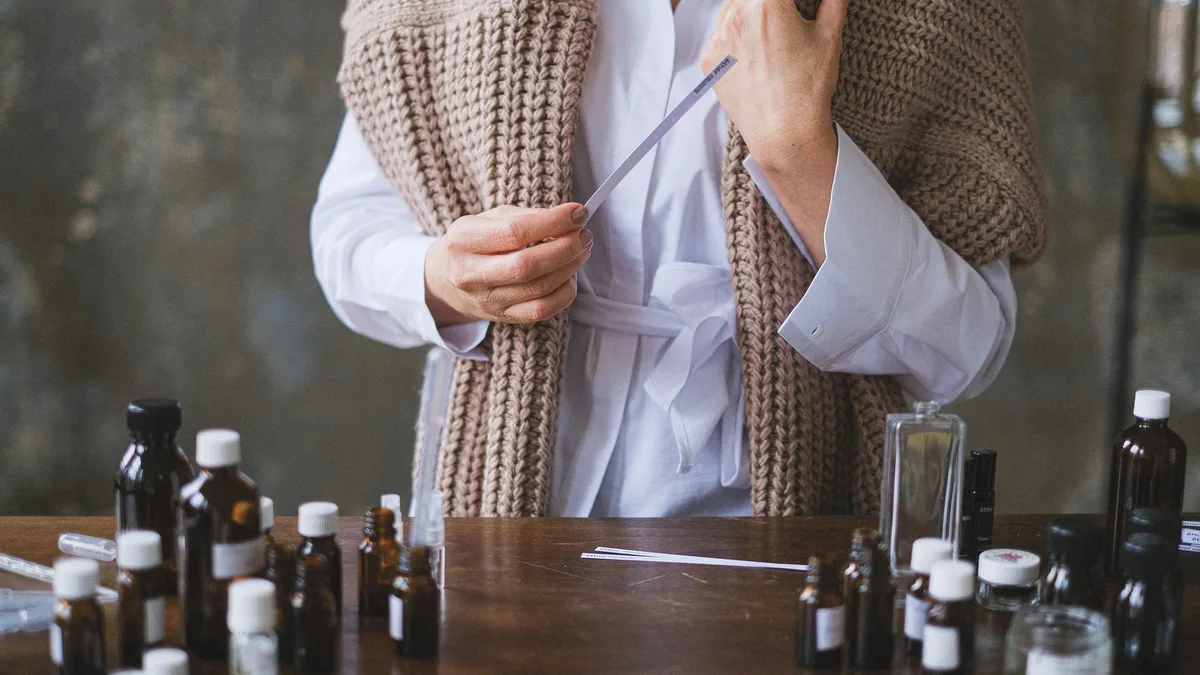
A blotter has a job, and it does exactly one thing well: it tells you whether a fragrance is worth looking into further. Beyond that it does not have much to say.
Paper has no skin temperature. It has no perspiration, no natural oils, none of the soap you showered with this morning. Yet it is the warmth of skin that lifts each group of fragrance molecules into the air in their own order. On paper, the alcohol evaporates, the lightest notes flare and fade, and what is left sits there as a still photograph.
So when you smell a strip, what you are smelling is essentially the top notes: citrus, mint, green notes, the lightest and fastest molecules in the formula. The heart usually only comes forward as the top notes fade, somewhere around twenty minutes to an hour after application. The base typically does not show itself until about thirty minutes in, and some musks are still detectable on fabric the next day.
Put another way: the part of the fragrance you will live with the longest is the part the strip never gets around to telling you about.
The assistant's wrist is not your wrist
Here is the other familiar scene. You hesitate, so the assistant sprays their own wrist and offers it to you. It does smell good. But what you are smelling is that fragrance plus that person's skin, not yours.
The difference is not mystical. It is fairly physical. Oily skin holds fragrance molecules longer than dry skin, body temperature varies from person to person, and your shower gel, moisturiser and fabric softener all contribute a base note of their own. On top of that, most of us here are perspiring for most of the year, and sweat tends to push the sweet and heavy parts of a formula forward.
The same bottle on two people can read noticeably differently by the drydown. That is why "it smells great on my friend" helps you less than you would hope.
Test over a day, not over ten minutes
The shortest rule we can give you: a proper test takes a day, not ten minutes.
Spray once or twice on skin, then leave it alone. Do not decide anything in the first hour. Come back to it at four hours, then at eight. If you still like the faint thing left on your wrist in the evening, you have learned something no strip could have told you.
A few conventions make that test more reliable.
- Test on skin, not on a shirt. Fragrance on fabric barely moves through its stages the way it does on skin, and it is far more stubborn if you change your mind.
- One fragrance at a time, and no more than two in a session. By the third, your nose stops separating them. Smell adapts quickly: a continuous odour fades until you can barely detect it, and sensitivity only returns once you have been away from it for a while. The jar of coffee beans at the counter does not fix that. Time and clean air do.
- Do not rub your wrists together. That reflex heats and breaks up the opening, so the fragrance unfolds distorted from how it was built. Spray and leave it.
- Spray from a distance, roughly a hand span, so it lands as a fine veil rather than a wet patch in one spot.
What a test day looks like
- In the morning, after your shower, spray once or twice on one wrist or the inside of an elbow. One fragrance only.
- Note your impression in the first five minutes. One line is enough.
- At two hours, smell it again. The heart has arrived by now.
- At four hours, smell it again, and more importantly, notice whether anyone around you mentions it.
- At the end of the day, before your shower, smell it one last time. That is the base, and that is what you will be wearing most.
- The next day, move to the second fragrance and repeat.
It sounds like a lot of work, but it takes no extra time out of your day. You go to work as usual. You are simply paying attention this time.
Test on an ordinary working day, not at home on a Saturday evening
This is where generic advice falls short, and in Vietnam it matters more than most places.
Testing in an air-conditioned shop, or at home in the evening when you have just showered and are sitting still, is testing under the best possible conditions. The real life of that bottle happens somewhere else.
Most of us commute by xe máy. That means a helmet strap across the jaw, a face mask over the lower half of the face, a sun jacket buttoned to the wrist, twenty minutes of street air, and an arrival that is politely described as damp. The helmet and mask sit exactly where people tend to spray, and fabric pressed against warm skin lifts part of a scent straight off it. The sun jacket keeps the rest underneath, so the moment you take it off, the morning's two sprays arrive all at once. And sweat shifts the balance of the whole formula.
A fragrance that tested beautifully in air conditioning can behave quite differently after twenty minutes in traffic. You want to know that before you pay for it rather than after.
Then there is the office: open plan, desks close together, air conditioning running all day and very little fresh air coming in. Air conditioning reduces projection, so your own scent seems to have faded while the person at the next desk still gets it clearly. And then the hardest test of the day, the shared lift. A sealed box, eight people, and nobody going anywhere for thirty seconds.
The real question is not "do I like this" but "do I want to carry this into a lift at eight in the morning and still feel comfortable". That is the question a fragrance counter cannot ask on your behalf.
What to actually write down
Do not rely on memory. After three days and three fragrances, they blur into one general impression. Open the notes app on your phone and give each one a few lines. The questions worth answering:
- Does it still please me at three in the afternoon? This is the most important line in the article. Three o'clock is when you are tired, the room is stale, and the fragrance has reached its base. A scent that still makes you happy at that hour is a scent worth buying.
- Did anyone mention it, and how? "That smells nice" and "what have you got on today" are two very different data points.
- Is it too loud in the lift?
- What is left on skin after four hours? Still there, but only if you put your nose to your wrist, is perfectly normal and not a fault.
- Did I want to top up, and why? If the reason was that it seemed to have gone, your nose has most likely just adapted while the fragrance is still entirely present.
- Did my skin react? Redness, itching or dryness where you sprayed is a reason to stop. Fragrance is a common cause of contact allergy, a reaction can develop after a period of use rather than on first contact, and if your skin shows a clear response it is worth seeing a dermatologist rather than pushing on.
You do not need to write well. You need to write while you are smelling it, not while you are remembering it.
Where a 5 ml or 10 ml decant fits
At this point the practical problem becomes obvious: to test the way we have just described, you need enough of a fragrance to last several days without buying the full bottle.
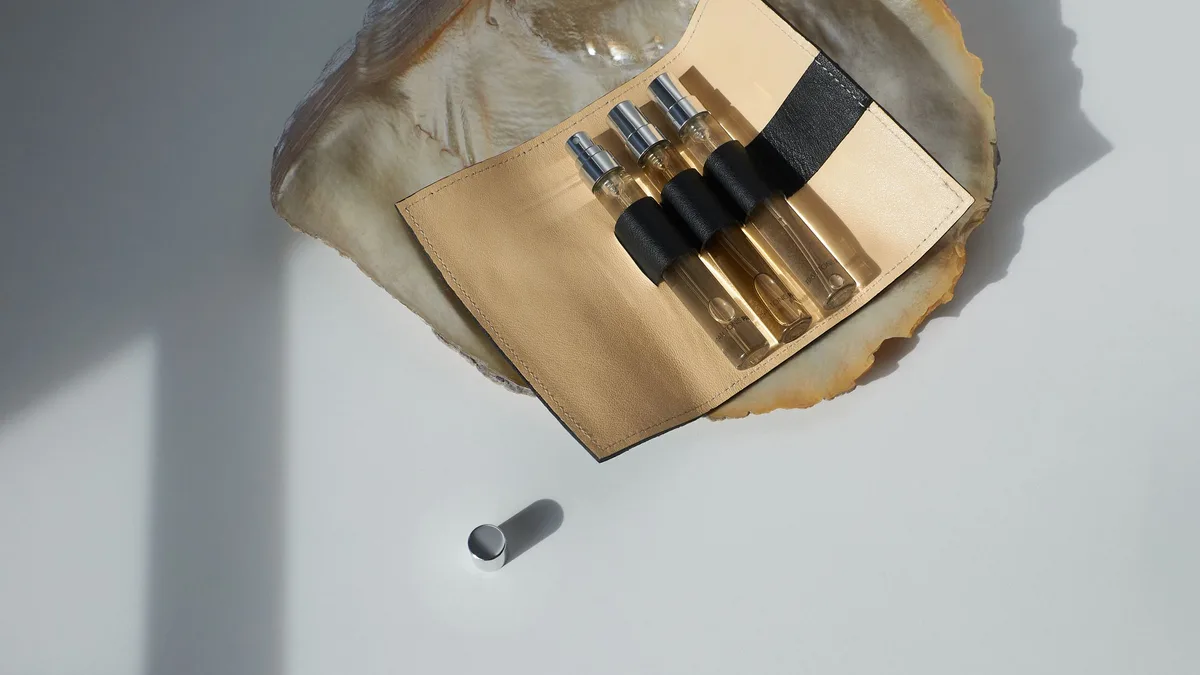
A 5 ml decant gives you a few dozen sprays, enough to carry one scent across genuinely different days: a blazing one, a wet one, a day of back-to-back meetings, an evening out. A 10 ml suits a fragrance you already like and want a longer run with before committing. Both cost a fraction of a gamble on a full bottle.
More useful than the price, though, is that decants let you test by season. A fragrance tested in Hanoi in December has not been tested for Saigon in June, and the reverse is just as true.
In the south the temperature sits somewhere around 30 to 35 degrees all year and the only real change is whether it is raining. The heat does the projecting for you, so two sprays there do the work of three or four somewhere cooler.
Hanoi is two problems in one year. Winter is genuinely cold and dry, often sitting between 10 and 15 degrees, and cold air holds a fragrance close to the skin, so you will find yourself spraying more rather than less for the same presence. Then spring brings nồm ẩm, roughly February to April, when the walls sweat and nothing in the wardrobe ever feels properly dry. In that weather, test on skin rather than on clothing: fragrance on fabric that is already holding moisture turns dull and stays that way all day.
So when you make your notes, write down which season you are testing for. A warm scent like Lattafa Khamrah, built on dates, cinnamon and vanilla over tonka bean, makes immediate sense for a December evening in the north and can easily become too much for an April afternoon in the south. Carolina Herrera Good Girl, with tuberose and jasmine over cocoa, tonka and praline, is rich and projects widely, so the lift test applies to it more strictly than usual. Dior Sauvage EDP runs citrus and vanilla, while Le Labo Santal 33 is dry and steady, opening with cardamom, violet and iris before settling into sandalwood, cedar and leather. Those four call for four different test days, and only your own skin on an ordinary day can tell you which one fits.
When you have enough to decide
We tend to tell people not to conclude anything on the first day, but also not to stretch a single fragrance past about two weeks. Beyond that you are not gathering information any more, you are postponing.
The clearest signal is usually not in your notes at all. It is which bottle your hand reaches for in the morning. If after a week you keep choosing the same one out of the shortlist without thinking about it, you have your answer.
And if none of them does that, the test was still not a failure. You have saved the cost of a full bottle and learned something about the direction that does not suit you.
Buying a perfume should not be a three-second bet at a counter. It should be the conclusion of a few days you actually spent living with the scent.
Sources
- Note (perfumery) · Wikipedia
- Olfactory fatigue · Wikipedia
- Fragrances and perfumes · DermNet
- SANTAL 33 | Eau De Parfum | Le Labo Fragrances · Le Labo
- Sauvage Eau de Parfum: Citrus Vanilla Fragrance - Refillable | Dior US · Dior
Written by The Vialdee team